
Full Coverage Insurance Doesn’t Mean Fully Protected After a Crash
Posted on March 7, 2023 at 7:00 PM by The Biker Lawyers , Updated: June, 4, 2026 at 10:00 AM

What “Full Coverage” Really Means After an Iowa Crash
Most people hear the phrase “full coverage” and think they are protected.
That is the problem.
“Full coverage” sounds complete. It sounds like if a crash happens, the insurance company will step in, cover the damage, pay the medical bills, replace the vehicle, and keep your family from taking the financial hit.
But that is not usually how auto insurance works.
Full coverage is not one magic policy. It is a loose phrase people use to describe a bundle of coverages.
“Full coverage” usually means a policy includes liability, collision, and comprehensive coverage. In Iowa, a policy may also involve other protections such as MedPay, uninsured motorist coverage, underinsured motorist coverage, gap coverage, rental reimbursement, towing, umbrella coverage, or custom parts coverage. But those protections are separate coverages with their own limits, exclusions, and conditions.
That fine print matters after a serious crash.
At The Biker Lawyers, we see this issue all the time. People think they have “full coverage,” then after a wreck they find out their policy does not cover what they thought it did. That problem hits especially hard for motorcyclists, because motorcycle crashes are more likely to cause serious injuries, bigger medical bills, time away from work, and expensive damage to the bike, gear, and custom parts.
This guide is not meant to sell you insurance or tell you exactly which policy to buy. That is a conversation to have with a licensed insurance agent. Our goal is simpler: help you understand what “full coverage” may not cover before a crash exposes the gap.
Quick Answer: What Is Not Covered by Full Coverage Insurance?
Full coverage insurance usually does not mean everything is covered. Depending on your policy, it may not fully cover your own injuries, medical bills above policy limits, lost wages, pain and suffering, damage caused by an uninsured or underinsured driver, custom motorcycle parts, riding gear, rental costs, loan gaps, excluded drivers, business use, or losses above your policy limits.
The exact answer depends on your declarations page (the page that summarizes the different types of coverage and the dollar amount of each), policy language, endorsements, deductibles, exclusions, and the facts of the crash.
That is why “I have full coverage” is not enough. The better question is: “What coverage do I actually have, and what happens if the crash is serious?”
Already dealing with a crash and finding out “full coverage” may not cover everything?
Insurance companies do not always explain every available source of recovery. Before you accept a settlement or sign a release, talk to a lawyer who understands Iowa crash claims, motorcycle insurance gaps, and how serious injuries can quickly exceed policy limits.
Contact The Biker Lawyers for a free consultation.
“Full Coverage” Is Not a Legal Promise

The phrase “full coverage” can be misleading because it is not usually a specific coverage listed on your policy.
Your policy is made of separate parts. Each part does a different job.
Liability coverage may protect you if you cause injuries or property damage to someone else. Collision coverage may help pay for damage to your own vehicle after a crash. Comprehensive coverage may help pay for certain non-collision damage, such as theft, fire, vandalism, hail, or hitting an animal.
Those are important coverages. But they are not the whole story.
A policy can have liability, collision, and comprehensive coverage and still leave you badly exposed after a serious crash. That is especially true if the other driver has no insurance, too little insurance, or if your injuries and losses are worth far more than the available coverage.
What “Full Coverage” Usually Includes

“Full Coverage” is a policy that usually includes at least these basic categories:
Liability Coverage
Liability coverage helps pay for injuries or property damage you cause to other people if you are at fault for a crash.
This does not pay for your own injuries. It does not repair your own vehicle. It protects you from claims made by others.
In Iowa, drivers are required to carry minimum liability coverage. Those minimum limits are commonly written as 20/40/15:
- $20,000 for bodily injury or death of one person in one accident
- $40,000 for bodily injury or death of two or more people in one accident
- $15,000 for injury to or destruction of someone else’s property
Those are minimums according to The Iowa Insurance Division, not recommendations. A serious crash can blow past those numbers quickly.
Collision Coverage
Collision coverage may help pay to repair or replace your vehicle if it is damaged in a crash, regardless of who caused the crash.
This is the coverage people often think of when they say they want their own car or motorcycle covered after a wreck. But collision coverage usually has a deductible, and it may only pay up to the vehicle’s actual cash value.
That can be a problem if your vehicle is worth less on paper than it costs to replace in the real world.
Comprehensive Coverage
Comprehensive coverage may help pay for damage that is not caused by a typical collision. This can include things like theft, vandalism, fire, hail, falling objects, flood damage, or hitting a deer.
For Iowa riders, this matters because deer strikes, storm damage, and theft can be real concerns.
But comprehensive coverage does not mean every type of damage is covered. It also does not cover your injuries from a crash.
Property Damage Coverage
Property damage coverage helps pay for damage you cause to someone else’s vehicle, motorcycle, fence, building, trailer, or other property if you are at fault for a crash.
This is usually part of your liability coverage.
It does not pay to fix your own vehicle. It protects you from property damage claims made by other people.
In Iowa, the minimum property damage liability requirement is commonly listed as $15,000. That may sound like a lot until you think about the cost of a newer truck, SUV, motorcycle, or commercial vehicle.
If you total someone else’s vehicle, damage more than one vehicle, or hit something expensive, minimum property damage coverage may not go very far.
Medical Payments Coverage
Medical payments coverage, often called MedPay, may help pay for medical bills after a crash, no matter who caused the accident.
This can include things like ambulance bills, emergency room treatment, doctor visits, X-rays, or other crash-related medical expenses.
MedPay can be helpful because medical bills can show up fast, often long before an injury claim is resolved.
But MedPay usually has a limit. Once that limit is used up, the coverage stops.
It also does not replace a full injury claim. It may help with medical bills, but it does not usually cover the full impact of a serious crash, including lost wages, long-term pain, future medical care, or how the injury affects your life.
Uninsured Motorist Coverage
Uninsured motorist coverage may help protect you if the driver who caused the crash does not have insurance.
This matters because even though Iowa drivers are required to carry insurance, not everyone follows the law.
If an uninsured driver hits you, there may be no liability insurance available from that driver to pay for your injuries.
That is where uninsured motorist coverage can become extremely important.
For riders, this can be a big deal. Motorcycle crashes often cause serious injuries, and serious injuries can mean expensive medical care, time off work, and long recoveries. If the at-fault driver has no insurance, your own uninsured motorist coverage may be one of the most important protections you have.
Underinsured Motorist Coverage
Underinsured motorist coverage may help protect you when the at-fault driver has insurance, but not enough to cover the damage they caused.
This is different from uninsured motorist coverage.
Uninsured means the other driver has no insurance. Underinsured means they have insurance, but their limits are too low.
For example, if a driver only carries Iowa’s minimum bodily injury limits, that may not come close to covering a serious motorcycle crash. Hospital bills alone can eat through minimum coverage fast.
Underinsured motorist coverage may help fill the gap between what the at-fault driver’s insurance can pay and what your claim may actually be worth, depending on your policy and the facts of the crash.
This is one of the biggest reasons “full coverage” can be misleading. You may have a policy that covers your vehicle, but still leaves you exposed if the person who hits you has too little insurance.
Why 20/40/15 may not be enough
Iowa’s minimum limits may satisfy the law, but they can fall short quickly after a serious motorcycle crash. A single ambulance ride, ER visit, surgery, or missed-work claim can create losses far beyond minimum coverage.
The Big Gap: Your Own Injuries May Not Be Fully Covered
This is where many people get surprised.
Your vehicle may be covered. Your liability to someone else may be covered. But your own body may not be covered the way you think it is.
If you are injured in a crash caused by someone else, the at-fault driver’s liability insurance may be one source of recovery. But if that driver has only minimum coverage, no insurance, or not enough insurance, you may be left looking to your own policy.
That is where uninsured motorist and underinsured motorist coverage matter.
Uninsured and Underinsured Motorist Coverage: The Coverage Riders Should Not Ignore

Uninsured motorist coverage, often called UM coverage, may help when the at-fault driver has no insurance or in certain hit-and-run situations.
Underinsured motorist coverage, often called UIM coverage, may help when the at-fault driver has insurance, but not enough to cover the harm they caused.
This coverage can be extremely important after a motorcycle crash.
Why? Because the driver who hits you may only have minimum coverage. If that driver causes a serious motorcycle crash, minimum coverage may not come close to paying for medical bills, lost income, long-term limitations, future care, pain, suffering, and the real disruption to your life.
Iowa policies generally must include uninsured and underinsured motorist coverage unless the named insured rejects it in writing. That is why riders should check their policy instead of assuming they have it. They should also check the limits.
There is another important point: UM/UIM bodily injury coverage does not pay for damage to your vehicle. It is for bodily injury caused by an uninsured or underinsured driver. If you want your vehicle covered for crash damage, you need to look at collision coverage.
“I Have UM/UIM” Is Not the Same as “I Have Enough UM/UIM”
Having uninsured or underinsured motorist coverage is a good start. But the amount matters.
A serious motorcycle crash can involve ambulance bills, ER care, surgery, hospital stays, physical therapy, missed work, future medical care, and permanent limitations. A low-limit policy can disappear fast.
This is one of the most important insurance conversations Iowa motorcyclists should have with a licensed insurance agent:
“If I get hit by a driver with no insurance or minimum coverage, what protection do I actually have?”
Do not just ask whether you have UM/UIM coverage. Ask how much you have, whether it applies to your motorcycle, whether it applies to passengers, whether it stacks, or is limited by policy language.
The Other Driver’s Insurance May Not Be Enough

A lot of injured people assume the at-fault driver’s insurance will take care of everything.
That only works if the at-fault driver has enough coverage.
Imagine a driver causes a crash and seriously injures a motorcyclist. The rider has a broken leg, a shoulder injury, surgery, months of missed work, and permanent pain. If the driver only has the Iowa minimum bodily injury limit, that insurance may be nowhere close to enough.
The insurance company does not simply pay more because the injuries are worse. The policy has a limit.
Once the available insurance is exhausted, the injured person may have to look for other sources of recovery. That could include their own UM/UIM coverage, umbrella coverage, another responsible party, or other legal options depending on the facts.
This is one reason serious injury cases need to be reviewed carefully.
Property Damage Coverage May Not Replace What You Actually Lost
Property damage coverage can be another rude awakening.
If someone totals your vehicle, the insurance company may look at actual cash value, not what you paid, what you owe, or what it costs to replace it with the same quality vehicle in today’s market.
For motorcyclists, this can get even more frustrating.
A bike is not always just a bike. It may have custom parts, upgraded seats, saddlebags, bars, pipes, floorboards, lights, paint, electronics, and other modifications that matter to the rider but may not be fully covered unless they were properly documented and insured.
Your riding gear may also be a separate issue. Helmets, jackets, boots, gloves, and protective gear can be expensive. Do not assume the insurance company will automatically pay full replacement value for every damaged item.
If your bike is customized, document it before a crash ever happens. Keep receipts. Take photos. Ask your insurance agent what custom parts and equipment coverage you have.
These days, it’s common for vehicles to cost $35,000 or more. You want to have enough coverage to pay for the other driver’s car if a crash is your fault. It’s a good idea to have at least $50,000 in property damage coverage.
Full Coverage May Not Cover the Gap on Your Loan
If your car, truck, or motorcycle is financed, there may be a gap between what you owe and what the vehicle is worth.
Collision or comprehensive coverage may pay actual cash value if the vehicle is totaled, but that amount may be less than your loan balance.
That difference is the gap.
Gap insurance may help cover that difference, depending on the policy. But gap coverage is not automatically included just because someone says you have full coverage.
This matters most for newer vehicles, financed motorcycles, long loan terms, rolled-over debt, and vehicles that depreciate faster than the loan balance goes down.
Medical Payments Coverage May Be Limited

Medical payments coverage, often called MedPay, may help pay medical bills for you or your passengers after a crash, regardless of who was at fault.
That can be useful, especially for deductibles, copays, early treatment, ambulance bills, or out-of-pocket medical expenses.
But MedPay is usually limited. It may be $1,000, $5,000, $10,000, or another amount depending on the policy. In a serious crash, that may only cover the first wave of bills.
MedPay is helpful. It is not the same as full injury protection.
Full Coverage May Not Cover Pain, Suffering, or Lost Income the Way You Think
Insurance policies are not all designed to pay every human loss directly.
After a serious crash, the losses may include:
- Medical bills
- Future medical care
- Lost wages
- Reduced earning ability
- Pain and suffering
- Loss of mobility
- Scarring or disfigurement
- Loss of normal life
- Emotional distress
- Long-term disability
Some of those losses may be part of a personal injury claim against an at-fault driver. Some may involve your own coverage. Some may be limited by policy language. Some may require proof before they are taken seriously.
This is where documentation matters.
Medical records, work records, photos, witness statements, crash reports, treatment history, and consistent follow-up care can all become important. Insurance companies do not pay serious injury claims just because a person says they are hurting. They look for proof.
Full Coverage May Not Cover Excluded Drivers or Excluded Uses
Insurance policies often contain exclusions.
That means there are situations where coverage may be denied or limited even though the policy exists.
Common issues may include:
- An excluded driver using the vehicle
- A driver without permission
- Commercial or business use not covered by the policy
- Rideshare or delivery app use without proper coverage
- Racing or organized speed events
- Intentional acts
- Misrepresentations on the policy application
- Lapsed coverage or missed payments
- Vehicles not listed properly on the policy
The details matter. If there is a coverage dispute after a crash, the policy language needs to be reviewed closely.
Full Coverage May Not Cover Rental, Towing, or Roadside Costs
People often assume rental reimbursement, towing, storage, and roadside assistance are included.
Sometimes they are. Sometimes they are not.
Those coverages are often optional add-ons. Even when they are included, there may be daily limits, maximum payout limits, approved vendor requirements, or other restrictions.
After a crash, towing and storage bills can pile up quickly. If your vehicle sits in a lot while the insurance companies argue, those costs can become a mess.
Full Coverage May Not Protect You From Insurance Company Pressure
This is the part insurance ads do not talk about.
Having coverage does not mean the claim will be easy.
After a crash, an insurance company may still question fault, argue about the value of your vehicle, dispute whether treatment was necessary, blame pre-existing conditions, downplay your injuries, question missed work, or try to settle before the full picture is clear.
This can happen even when you did nothing wrong.
For motorcyclists, there is another layer: rider bias.
A driver may say, “I never saw the motorcycle.” An adjuster may question speed. Someone may bring up helmets, lane position, clothing, weather, or assumptions about how bikers ride. Those arguments can start shaping the claim early.
Coverage matters. But coverage does not replace having someone protect the story of what actually happened.
Why Motorcyclists Need to Review Coverage Differently
Motorcyclists face different risks than drivers in enclosed vehicles.
A car crash may bend metal. A motorcycle crash often throws the rider into the road.
That difference changes the insurance conversation.
Riders should not only ask, “Is my bike covered?” They should ask:
- What happens if I am hit by a driver with minimum insurance?
- What happens if the driver has no insurance?
- What happens if I have a passenger?
- Are my custom parts covered?
- Is my riding gear covered?
- Do I have MedPay?
- Do I have UM/UIM coverage?
- What are my UM/UIM limits?
- Does my umbrella policy include UM/UIM coverage?
- Does my policy cover every bike I ride?
- Are there exclusions I need to know about?
That conversation may feel boring before a crash. After a crash, it can become one of the most important conversations you wish you had sooner.
A Simple Insurance Coverage Checklist
Motorcycle Insurance Coverage Checklist (Click to Enlarge)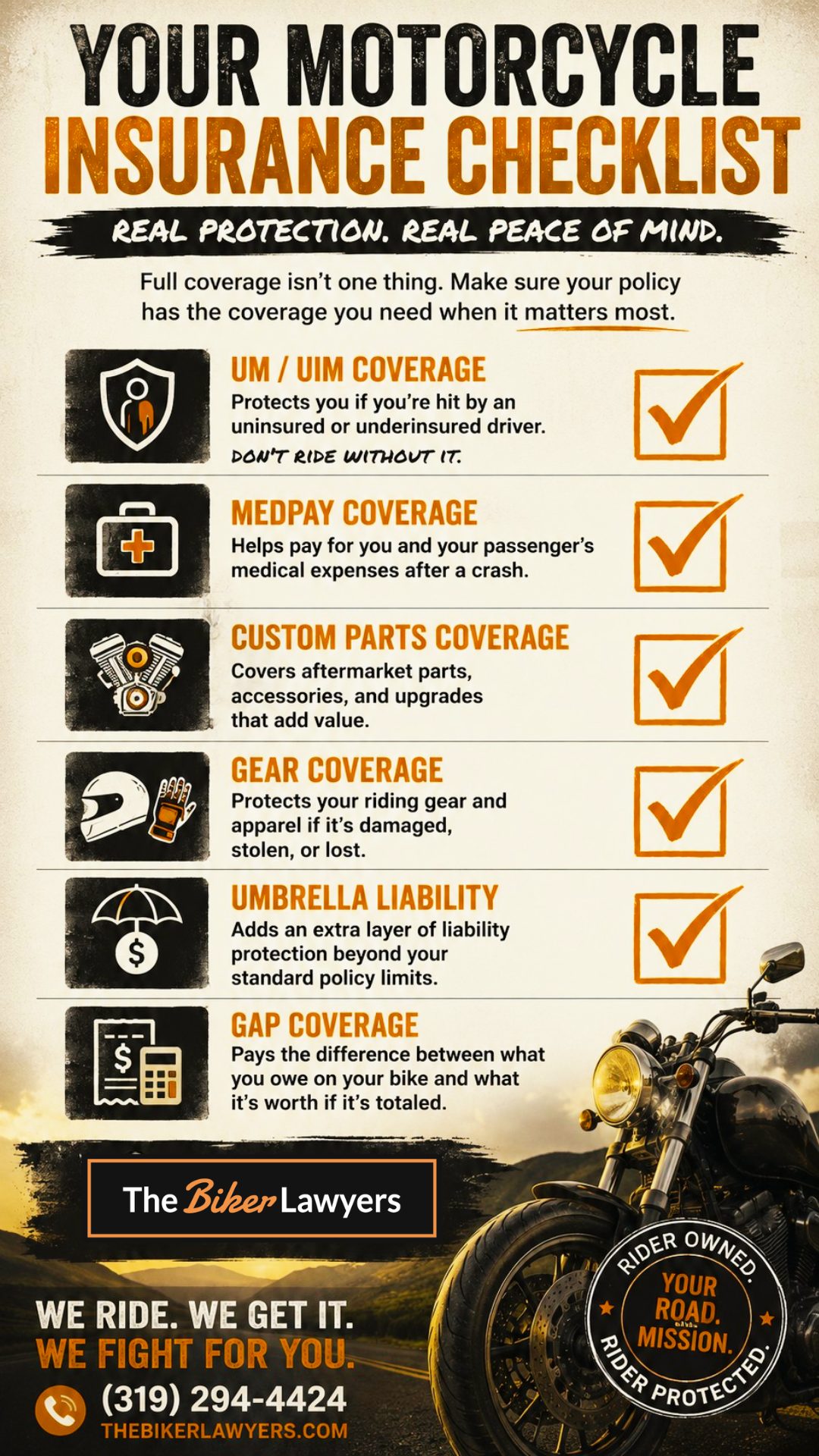
Before riding or driving, pull out your declarations page and ask your insurance agent to walk you through it.
Do not just ask whether you have “full coverage.” Ask about each part:
Liability Coverage
How much protection do you have if you cause a crash and injure someone else?
Collision Coverage
Will your own vehicle be repaired or replaced after a crash? What deductible applies?
Comprehensive Coverage
Are theft, fire, hail, vandalism, animal strikes, and other non-collision losses covered?
UM/UIM Coverage
What protection do you have if the driver who hurts you has no insurance or not enough insurance?
Medical Payments Coverage
Do you have MedPay? If so, how much?
Custom Parts and Equipment
Are motorcycle upgrades, accessories, and custom parts covered? Up to what amount?
Gear Coverage
Does the policy cover damaged helmets, jackets, boots, gloves, and other riding gear?
Gap Coverage
If the vehicle is totaled, will you still owe money on the loan after insurance pays actual cash value?
Rental, Towing, and Storage
Are these covered? What are the limits?
Umbrella Coverage
Do you have extra liability protection? Does it include UM/UIM protection or only liability?
What To Do If You Were Already in a Crash
If you were already in a crash and are now discovering that “full coverage” may not mean what you thought, take a breath.
Do not assume you are out of options.
You may need to review:
- The at-fault driver’s liability coverage
- Your own UM/UIM coverage
- Your collision coverage
- Your MedPay coverage
- Any umbrella policy
- Other household policies
- Whether another person or company may share fault
- Whether the insurance company is applying the policy correctly
- Whether the settlement offer accounts for the full harm done
Do not rely only on what an adjuster says over the phone. Get the policy. Get the declarations page. Keep every letter and email. Save photos, medical records, repair estimates, towing bills, and wage loss information.
If injuries are serious, get legal guidance before signing a release.
Once a release is signed, you may be giving up your right to ask for more money later, even if your injuries turn out to be worse than you knew.
The Bottom Line: Full Coverage Is a Starting Point, Not a Safety Net
Full coverage may protect you from some common problems. It may help repair your vehicle. It may satisfy a lender. It may give you more protection than minimum liability coverage.
But it does not automatically mean you are fully protected.
The real question is not whether you have “full coverage.”
The real question is whether your coverage matches the risk you face.
For Iowa motorcyclists, that risk can be serious. One careless driver, one missed stop sign, one left turn, one distracted glance, or one “I never saw them” crash can change everything.
Before that happens, review your coverage with a licensed insurance agent.
After it happens, review your case before you trust the insurance company’s answer.
Full Coverage Insurance FAQ
Click the (+) on any of the questions below.Does full coverage insurance cover everything after a crash?
No. Full coverage is not a guarantee that every loss will be paid. It usually refers to a combination of liability, collision, and comprehensive coverage, but every policy has limits, deductibles, exclusions, and coverage gaps.
What is usually included in full coverage auto insurance?
Full coverage usually means the policy includes liability coverage, collision coverage, and comprehensive coverage. Some policies may include additional protection, but you should check your declarations page and policy language to know exactly what you have.
Does full coverage pay for my injuries?
Not always. Liability coverage usually pays for injuries you cause to someone else, not your own injuries. Your own injuries may involve MedPay, health insurance, uninsured motorist coverage, underinsured motorist coverage, or a claim against the at-fault driver.
Does uninsured or underinsured motorist coverage pay for damage to my vehicle?
Uninsured and underinsured motorist bodily injury coverage is for bodily injury caused by an uninsured or underinsured driver. It does not cover damage to your vehicle. Vehicle damage is usually handled through collision coverage or the at-fault driver’s property damage coverage, depending on the facts.
Is Iowa’s minimum liability insurance enough?
Iowa’s minimum liability limits are 20/40/15. Those limits may satisfy the legal minimum, but they may not be enough after a serious crash. Medical bills, vehicle damage, lost wages, and other losses can exceed minimum coverage quickly.
Why is UM/UIM coverage so important for motorcyclists?
Motorcyclists are more exposed in a crash, so injuries can be severe. If the at-fault driver has no insurance or only minimum coverage, UM/UIM coverage may be one of the most important sources of protection available to the injured rider.
Does full coverage cover custom motorcycle parts?
Not always. Custom motorcycle parts, accessories, upgrades, and riding gear may be limited or excluded unless your policy includes coverage for them. Riders should document upgrades and ask their insurance agent how those items are covered.
Should I talk to a lawyer before accepting an insurance settlement?
If the crash caused injuries, painful symptoms, medical bills, missed work, or a damaged vehicle, it is smart to speak with a lawyer before signing a release. Once you settle, you cannot get more later, even if circumstances change.
Injured in a Crash and Not Sure What Insurance Covers?
If this sounds like your situation, The Biker Lawyers can review what happened and help you understand your options.
You do not have to know whether you have a case before you call. That is what the consultation is for.
If you were injured in a motorcycle accident, car accident, truck crash, or another serious wreck in Iowa or the Midwest, contact The Biker Lawyers for a free case review.
Call (319) 294-4424 or contact us online.