
Safe Motorcycle Group Riding: How to Ride Together Safely
Posted on June 2, 2026 at 9:00 AM by The Biker Lawyers

There is nothing quite like rolling into a bike night, rally, benefit ride, or weekend run with a crew of riders you trust.
The sound. The formation. The feeling of being part of something bigger than yourself. That is one of the best parts of the biker community.
But group riding is not the same as riding alone.
When one rider makes a bad decision, misses a signal, crowds another bike, or tries to show off, everybody around them feels it. A good group ride is not about control. It is about respect. Respect for the road, respect for the riders around you, and respect for the people sharing the highway with you.
At The Biker Lawyers, we ride too. We have been part of plenty of organized rides across Iowa and the Midwest, and we know the difference between a smooth, safe group ride and a rolling mess waiting to happen.
This guide breaks down how to ride together with more confidence, better communication, and fewer surprises.
Group Riding vs. Mass Riding: There Is a Big Difference
Not every motorcycle ride with a bunch of bikes is the same kind of ride.
A mass ride is usually loose. There may be a starting point and an ending point, but once the ride begins, the group may stretch out, split up, or operate with very little structure. These rides can still be fun, but they depend heavily on each individual rider making smart choices.
A true team ride is different.
A team ride has a plan. Riders know the route. Road captains understand their roles. The group uses clear signals, safe spacing, and agreed-upon formations. Nobody is guessing where to go next, who is leading, or what happens if someone has a problem.
The goal is simple: have a great time, and get everyone there safely.
That does not mean a team ride has to feel stiff or overmanaged. It just means the ride has enough structure to keep the group from turning into chaos.
Before the Ride: Every Rider Has a Job
A safe group ride starts before the kickstands go up.
Every rider should show up ready. That means arriving on time, fueled up, hydrated, and prepared to ride the planned route. Nobody wants to delay the group because someone rolled in late, needed gas right away, or had a mechanical issue that should have been caught at home.
Before joining a group ride, each rider should check the basics:
- Tires and tire pressure
- Brakes
- Headlight, taillight, and turn signals
- Fluids
- Mirrors
- Chain or belt condition
- Fuel level
- Weather-appropriate gear
- Phone charge
- Emergency contact information
It is also smart to carry a basic first aid kit, water, a small tool kit, insurance information, and any medical information a first responder may need in an emergency.
A group ride only works when each rider takes responsibility for their own machine and their own behavior.
Ride Your Own Ride, Even in a Group
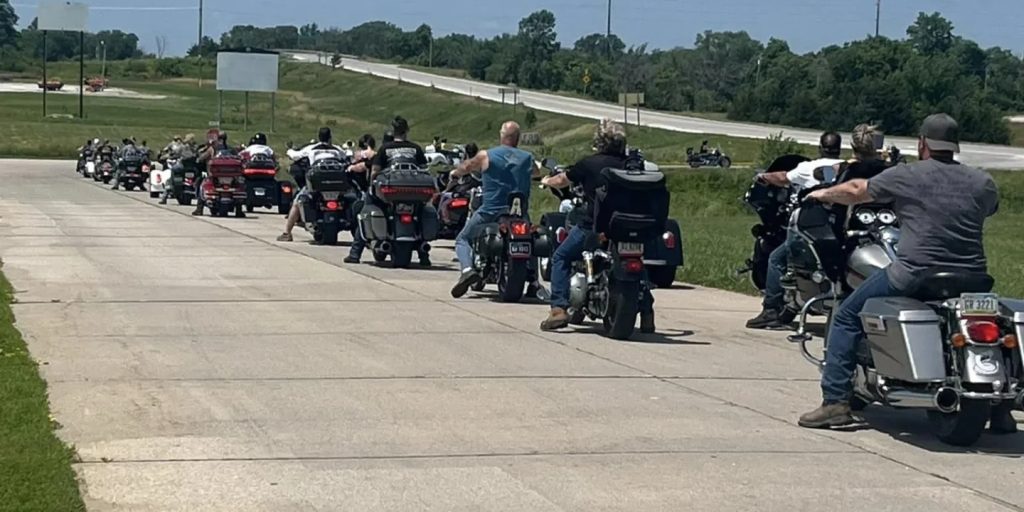
One of the most important rules of group riding is this: ride your own ride.
You are part of the group, but you are still responsible for your own bike, your own lane position, your own speed, and your own safety decisions.
Do not ride faster than your comfort level just because the person ahead of you is pushing harder than you would. Do not follow someone through an intersection just because they made it. Do not assume the group protects you from bad drivers, road hazards, gravel, animals, or debris.
A safe group does not pressure riders to keep up at all costs.
A good lead rider understands the pace of the least experienced rider. A good group leaves room for people to react. A good rider knows when to back off, create space, or speak up.
Anyone can lead a group of riders, but the Lead Road Captain (LRC) manages the group.
Why Road Captains Matter
In a well-organized motorcycle ride, road captains help keep the group together and moving safely.
The names may vary depending on the club, riding group, or event, but the basic roles are usually the same.
Lead Road Captain
The Lead Road Captain runs the ride from the front. This rider should know the route, the stops, the road conditions, and the overall plan. They set the pace, watch for hazards, choose safe pull-off spots when needed, and make decisions when traffic, weather, or road construction changes the plan.
Anyone can ride in front. Not everyone can lead a group.
A Lead Road Captain needs experience, calm judgment, and the ability to think ahead. They should not be riding for ego. They should be riding for the group.
Middle Road Captain
A Middle Road Captain helps monitor the center of the group. This rider can spot problems that the lead rider may not see right away, including spacing issues, riders falling behind, or confusion during lane changes and turns.
In larger groups, this role can be especially important because the front and back of the ride may experience traffic signals, congestion, or hazards differently.
Drag or Sweep Road Captain
The Drag Road Captain, sometimes called the Sweep, rides at the back.
This rider makes sure nobody gets left behind. If a rider breaks down, misses a turn, or has an emergency, the Drag Road Captain is usually the one who stops and helps while the rest of the group gets to a safe place.
This role matters. A group ride should never leave a rider stranded on the side of the road without a plan.
What the Lead Road Captain Should Plan Before the Ride
Good group rides do not happen by accident.
Before the ride, the Lead Road Captain should review the route and identify gas stops, rest stops, food stops, construction zones, detours, and safe regrouping points. For longer rides, stops every 80 to 100 miles often make sense, but the route, weather, and riders may require shorter stretches.
The night before the ride, the lead should check the weather, road closures, construction updates, and any known hazards along the route.
On the day of the ride, the lead should arrive early and be ready to brief the group.
That pre-ride briefing should cover:
- The route
- Planned stops
- Fuel expectations
- The lead, middle, and drag riders
- Basic hand signals
- Formation expectations
- What to do if the group gets separated
- What to do if someone breaks down
- Emergency plan if there is a crash
This does not need to be a long speech. It just needs to be clear.
Keep the Group Manageable
Bigger does not always mean better.
Large motorcycle groups are harder for traffic to accommodate, and harder for riders to manage safely. When possible, larger rides should be broken into smaller groups with their own lead and drag riders.
A smaller group is easier to keep together. It is also easier to move through intersections, merge onto highways, respond to hazards, and pull off safely if something goes wrong.
If the ride is big enough that the front and back of the group are having two different traffic experiences, it may be time to split the ride into sections.
Staggered Formation: The Default for Most Group Riding

A staggered formation helps motorcycle groups stay organized while giving each rider room to react.
For most normal roads and good conditions, a staggered formation is the standard choice for motorcycle group riding.
In a staggered formation, the lead rider usually rides in the left third of the lane. The second rider rides at least one-and-a-half second behind in the right third of the lane. The pattern continues through the group.
This creates a compact group without forcing riders side by side.
That matters because side-by-side riding cuts down the space each rider has to react. If a pothole, animal, tire chunk, patch of gravel, or sudden stop appears, each rider needs room to move.
Staggered formation helps the group stay visible and organized while still giving each rider space.
When to Switch to Single File
Staggered formation is useful, but it is not always the safest choice.
Single file is usually better when riders need more room to choose their line or react to changing conditions.
A group should consider switching to single file when:
- Riding through curves or twisty roads
- Road surfaces are rough, wet, narrow, or damaged
- Visibility is poor
- Passing pedestrians, bicyclists, or roadside hazards
- Entering or exiting highways
- Riding through construction zones
- Approaching blind hills
- Passing or being passed by large trucks
- Weather conditions make control more difficult
Single file gives every rider more lane space. It also helps prevent riders from feeling boxed in when the road gets technical.
Do Not Pass Within the Group
Once the ride is underway, riders should not pass each other inside the group unless there is a clear safety reason and the move is communicated.
Passing inside the group creates confusion. It changes spacing. It breaks trust. It can also surprise riders who are already watching traffic, road conditions, and signals from the front.
If a rider wants or needs to change position, that should usually happen at a stop, not in motion.
Group riding works best when everybody knows where they belong.
Motorcycle Hand Signals Every Group Rider Should Know
Turn signals and brake lights matter, but hand signals add another layer of communication.
They are especially useful when the group is stretched out, riding in bright sunlight, dealing with traffic, or moving through areas where riders may not all see the same hazard at the same time.
Common group riding hand signals include:
- Single file: Arm and index finger extended straight up.
- Staggered formation: Arm extended upward with the index and pinky fingers extended.
- Hazard on the road: Point toward the hazard with a hand or foot.
- Follow me: Arm extended from the shoulder with palm forward.
- Left turn: Left arm extended straight out.
- Right turn: Left arm extended out and bent upward at the elbow.
- Stop: Arm extended down with palm facing back.
- Slow down: Arm extended out and moved downward repeatedly.
- All good or I’m okay: Tap the helmet or top of the head with an open hand.
The key is consistency. If the group uses signals differently, explain that before the ride starts.
What to Do If the Group Gets Split Up

Sooner or later, a group will get separated.
A traffic light changes. A car cuts in. A driver hesitates at an intersection. A rider has to slow down for a hazard. It happens.
The answer is not to race, make sudden lane changes, or pressure riders to beat the light.
The safer plan is to discuss regrouping before the ride starts.
If part of the group gets separated, the lead should continue to a safe, planned pull-off area when possible. The temporary lead and drag riders in the separated section should keep that smaller group calm and together until everyone can regroup.
No ride is worth turning a small separation into a crash.
What to Do If There Is a Breakdown
If a bike breaks down, the whole group should not scatter across the shoulder.
The Drag Road Captain or another designated rider should stop with the rider who has the problem. The rest of the group should continue to a safe location where they can wait without blocking traffic or creating a second hazard.
The goal is to protect the rider, protect the group, and keep the roadside situation from becoming more dangerous.
If the breakdown happens in a bad location, the first priority is getting people away from traffic.
What to Do If There Is a Motorcycle Crash During a Group Ride
If there is a crash during a group ride, the ride is over.
At that point, the focus shifts from getting to the destination to protecting people and preserving safety.
The group should:
- Get out of the flow of traffic if possible
- Call 911 right away if anyone may be hurt
- Avoid moving an injured rider unless there is immediate danger
- Warn approaching traffic if it can be done safely
- Provide first aid only within the limits of the rider’s training
- Keep calm and avoid crowding the scene
- Take photos or notes only when it is safe and appropriate
- Cooperate with law enforcement and emergency responders
If another driver caused the crash, or if there are serious injuries, it is also important to protect the injured rider’s rights. That does not mean arguing at the scene. It means getting medical help, documenting what happened, identifying witnesses, and speaking with an attorney before dealing too deeply with the insurance company.
Gear Still Matters in a Group Ride
Group riding does not make anyone invincible.
Good gear still matters. That includes a helmet, eye protection, gloves, jacket, long pants, and boots. Riders should dress for the slide, the weather, and the ride ahead.
It is also smart to carry water, especially during hot Iowa riding season. Dehydration can sneak up fast, and tired riders make worse decisions.
A Quick Safety Checklist for Motorcycle Group Rides
Before the ride:
- Know the route
- Know the stops
- Fuel up
- Check your bike
- Bring emergency information
- Attend the pre-ride briefing
- Know the road captains
- Understand the signals
During the ride:
- Ride your own ride
- Keep safe spacing
- Do not pass within the group
- Use hand signals clearly
- Watch the rider behind you
- Switch to single file when conditions call for it
- Obey traffic laws
- Do not pressure the group through intersections
After the ride:
- Check in with newer riders
- Talk through any close calls
- Thank the road captains
- Fix problems before the next ride
The best groups keep learning. That is how a crew gets stronger.
Safe Group Riding Is About Trust
A good motorcycle group ride feels smooth because every rider is doing their part.
The lead rider is planning ahead. The drag rider is watching the back. The group is communicating. Riders are leaving space. Nobody is trying to prove anything.
That is how you get the good kind of ride. The kind where everyone rolls in together, parks safe, laughs about the road, and knows they looked out for each other.
That is biker culture at its best.
Group Ride FAQ
Click the (+) on any of the questions below.Is it safer to ride a motorcycle alone or in a group?
It depends on the riders and how the group is organized. A well-planned group ride with experienced Road Captains, clear communication, and safe spacing can be enjoyable and orderly. A poorly organized group ride can increase risk because riders may crowd each other, miss signals, or feel pressured to ride beyond their comfort level.
What is the safest formation for motorcycle group riding?
For normal road conditions, a staggered formation is commonly used because it keeps the group compact while still giving riders room to react. Single file is usually better on curves, narrow roads, rough surfaces, poor visibility, construction zones, and other situations where riders need more room to maneuver.
Should motorcycle riders ride side by side in a group?
Side-by-side riding is generally not recommended because it reduces each rider’s space cushion. If one rider needs to avoid a hazard or make a sudden move, riding directly beside another motorcycle can leave too little room to react safely.
What does a Road Captain do in a motorcycle ride?
A Road Captain helps organize and manage the ride. Depending on the role, they may lead the group, monitor the middle, or ride in the back as the sweep. Road Captains help with route planning, pacing, communication, regrouping, breakdowns, and emergency response.
What should I do if I am injured during a motorcycle group ride?
Get medical help first. If you can do so safely, document the scene, identify witnesses, take photos, and avoid making detailed statements to insurance companies before speaking with an attorney. Motorcycle group ride crashes can involve several possible factors, including another driver, unsafe road conditions, or rider behavior within the group.
Final tips for safe team riding
Make sure to wear proper safety gear. Leave the tennis shoes, flip-flops, and shorts at home. Instead, consider a helmet, gloves, a jacket and or vest, boots, long pants, and be sure to carry a medical information sheet in your saddle bag. It’s also a good idea to keep an extra bottle or two of water.
Again, safe motorcycle team riding starts with individual safety.
Below is an infographic with 6 simple steps to riding safely.

Injured in a Motorcycle Accident During a Group Ride?
Even careful riders can get hurt when another driver makes a bad move, a road hazard appears without warning, or a group ride turns dangerous because someone failed to ride responsibly.
If you were injured in a motorcycle crash in Iowa or the Midwest, The Biker Lawyers can review your situation and help you understand your options.
You do not have to know whether you have a case before you call. That is what the consultation is for.
If this sounds like your situation, contact The Biker Lawyers for a free case review.
Call (319) 294-4424 or contact us online.
If you found this article helpful, click below for another we think you’ll like!





